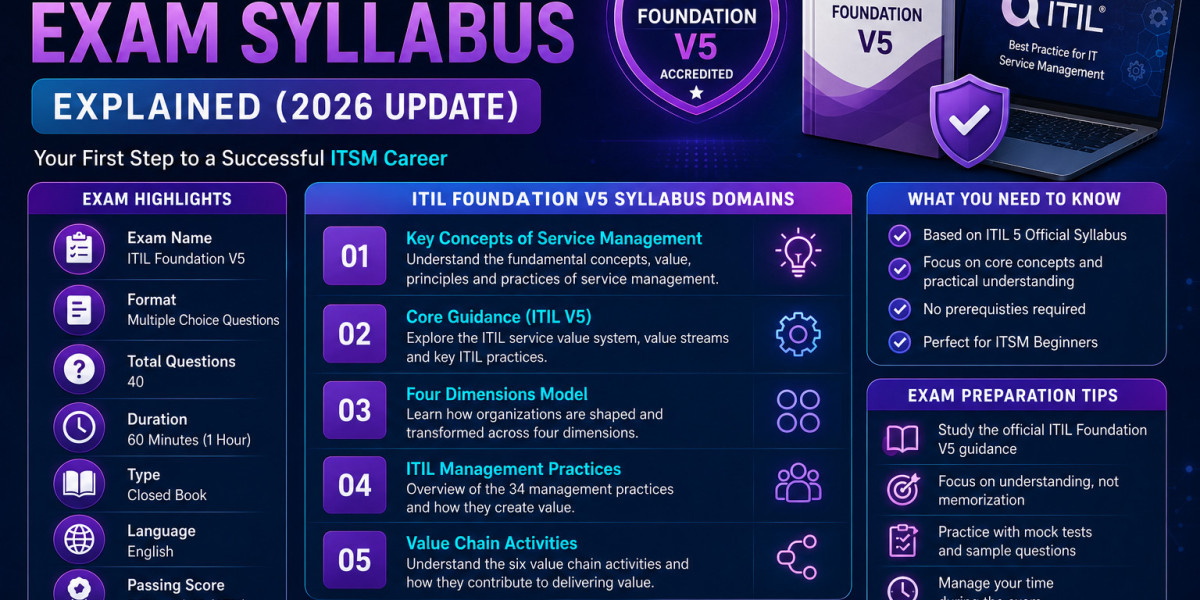

The ITIL Foundation V5 certification introduces professionals to the latest concepts in modern IT Service Management (ITSM). As organizations continue adopting digital services, cloud technologies, automation, and AI-assisted operations, ITIL has evolved to reflect these changing business requirements. The updated syllabus focuses on delivering value through products and services while helping professionals understand how IT supports business success.
Whether you are preparing for your first ITIL certification or updating your knowledge after previous versions, understanding the complete syllabus is the first step toward effective exam preparation. Rather than memorizing definitions, candidates should understand how the different concepts connect and contribute to delivering high-quality IT services.
This guide explains the ITIL Foundation V5 syllabus in simple language and highlights the key areas you should study for the 2026 exam.
Why the Syllabus Matters
Every certification exam is built around its official syllabus.
Understanding the syllabus helps candidates create a structured study plan, identify important topics, and spend more time on areas that carry greater weight in the examination. Instead of studying randomly, you can prepare according to the knowledge areas expected in the exam.
A clear understanding of the syllabus also makes practice questions more meaningful because you know exactly which objectives each question is testing.
Watch the Cert Empire YouTube ITIL certification guide.
Overview of the ITIL Foundation V5 Syllabus
The Foundation syllabus introduces the core principles of modern digital product and service management. It explains how organizations create value, deliver services, improve customer experiences, and continually optimize their operations.
The syllabus is organized into several major learning areas that gradually build your understanding of IT Service Management.
Syllabus Area | Main Focus |
Key ITIL Terms and Definitions | Core terminology and essential concepts |
Digital Products and Services | Understanding products, services, and value |
Service Relationships | Roles, responsibilities, and stakeholders |
Product and Service Lifecycle | Planning, delivering, supporting, and improving services |
Value System | Creating value through integrated practices |
Continual Improvement | Improving services and business outcomes |
AI and Modern ITSM | Understanding AI within service management |
Related Frameworks | How ITIL works alongside other frameworks |
Each section builds upon the previous one, making it important to study the syllabus in sequence rather than skipping topics.
Key ITIL Terms and Definitions
The first section introduces the vocabulary used throughout the certification.
Candidates should understand concepts such as:
Product
Service
Service management
Digital products
Digital services
Value
Value co-creation
Continual improvement
Outcomes
Outputs
Costs
Risks
Many examination questions begin by testing your understanding of these fundamental terms because they are used throughout the remaining syllabus.
Digital Products and Services
This section explains how organizations create and deliver value.
Rather than viewing technology as isolated systems, ITIL emphasizes delivering complete products and services that satisfy customer needs. Candidates learn how organizations combine people, technology, information, and processes to create business value.
Understanding the relationship between products, services, and customer outcomes is essential because many scenario-based questions rely on these concepts.
Service Relationships
Modern service management depends on collaboration between multiple stakeholders.
This part of the syllabus explains:
Service providers
Service consumers
Partners
Suppliers
Internal teams
External organizations
Candidates learn how these groups interact throughout the service lifecycle and contribute to delivering successful business outcomes.
Understanding these relationships helps explain why effective communication and collaboration are important within IT Service Management.
Product and Service Lifecycle
One of the most important additions to the updated syllabus is the emphasis on the complete lifecycle of digital products and services.
Candidates should understand how organizations:
Plan services
Design solutions
Deliver value
Support customers
Monitor performance
Improve services continuously
Rather than treating service delivery as separate activities, ITIL presents them as connected stages that contribute to ongoing business success.
Understanding the Value System
The value system explains how organizations convert opportunities into measurable business value.
This section introduces concepts such as:
Value creation
Organizational objectives
Service value streams
Governance
Decision-making
Collaboration
Continuous feedback
Candidates should understand how these components work together to deliver consistent service quality while supporting continual improvement.
Questions from this section often require candidates to apply concepts rather than simply recall definitions.
Continual Improvement
Continual improvement is a core concept covered in the ITIL Foundation V5 Exam and is not treated as a one-time project within ITIL.
Instead, organizations are encouraged to review their processes, measure performance, collect feedback, identify opportunities, and implement improvements on an ongoing basis.
For the ITIL Foundation V5 Exam, candidates should understand how continual improvement supports better customer experiences, improves operational efficiency, and contributes to long-term organizational success.
Many scenario-based questions in the ITIL Foundation V5 Exam require candidates to identify the most effective continual improvement approach for a given business situation.
Artificial Intelligence in IT Service Management
The updated syllabus recognizes the growing importance of Artificial Intelligence within IT operations.
Candidates should understand how AI can support activities such as:
Service automation
Incident analysis
Knowledge management
Predictive support
Operational efficiency
Decision support
The objective is not to become an AI specialist but to understand how intelligent technologies contribute to modern service management.
Preparation Strategy
The syllabus covers a broad range of connected concepts, making structured preparation especially important.
Begin by studying one syllabus area at a time before reviewing how each topic connects with the others. Practice answering scenario-based questions because many exam items test your ability to apply concepts rather than memorize terminology.
Regular revision sessions help reinforce key definitions while improving confidence before the examination.
Many successful candidates also strengthen their preparation using updated practice questions, mock exams, and study materials available through Cert Empire.
Conclusion
The ITIL Foundation V5 syllabus reflects the evolution of modern IT Service Management by combining traditional service management principles with digital products, continual improvement, value creation, and emerging technologies such as Artificial Intelligence.
Rather than focusing solely on memorization, candidates should understand how the different syllabus areas work together to support business objectives and deliver value. A structured study plan, regular practice, and a clear understanding of each syllabus section provide an excellent foundation for certification success.
FAQs
What topics are covered in the ITIL Foundation V5 syllabus?
The syllabus includes key terminology, digital products and services, service relationships, the product and service lifecycle, value systems, continual improvement, Artificial Intelligence, and related service management concepts.
Is the ITIL Foundation V5 syllabus suitable for beginners?
Yes. The Foundation certification is designed for beginners as well as experienced IT professionals who want to understand modern IT Service Management principles and best practices.
Does the updated syllabus include Artificial Intelligence?
Yes. The updated syllabus introduces Artificial Intelligence concepts and explains how AI supports modern service management through automation, operational efficiency, knowledge management, and improved decision-making.
How should I prepare for the ITIL Foundation V5 syllabus?
Study one syllabus section at a time, review key terminology regularly, practice scenario-based questions, and maintain a consistent study schedule until every objective is well understood.
Is understanding the syllabus enough to pass the exam?
Understanding the syllabus provides a strong foundation, but candidates should also complete practice questions, timed mock exams, and regular revision sessions to improve confidence and exam readiness.
Learn More: https://reportrave.com/itil-foundation-v5-exam-pattern-questions-passing-score/


