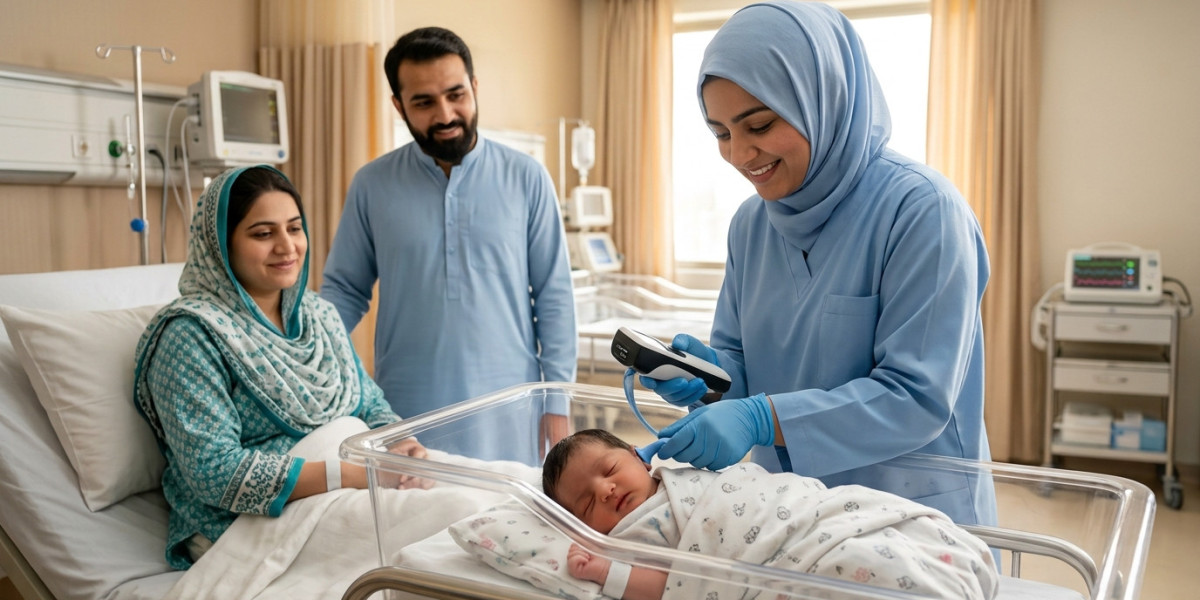

Your baby was born healthy, passed every visible check, and went home within days. Somewhere in that discharge process, hearing screening may or may not have happened, and if it didn’t come up, it’s easy to assume it simply wasn’t necessary. In Pakistan, newborn hearing screening still isn’t universal the way it is in many countries, and that gap quietly delays diagnosis for babies who do have hearing loss, sometimes by years.
Why Hearing Loss Is Easy to Miss in a Newborn
Hearing loss in a newborn produces no visible signs. A baby with significant hearing loss still startles at sudden vibrations, still sleeps and feeds normally, and looks entirely typical to a parent or even a general physician doing a standard newborn check.
Without a specific hearing screening test, moderate to severe hearing loss can go completely unnoticed for months, sometimes not becoming apparent until a toddler isn’t developing speech on the expected timeline, well past the point where earlier intervention would have been possible.
This is precisely why hearing screening exists as a distinct, dedicated test rather than something folded into a general newborn exam. It catches what simple observation cannot.
How Newborn Hearing Screening Actually Works
The standard screening test, typically an otoacoustic emissions test or an automated auditory brainstem response test, is quick, painless, and can be done while a baby sleeps, usually within the first day or two of life.
The test doesn’t diagnose the specific cause or severity of any hearing difference. It’s a screening tool designed to flag babies who need further, more detailed testing, distinguishing them from the majority who pass and need no further action. Follow-up testing, along with any related speech and language monitoring, is best coordinated with a Child Speech Therapist Lahore from early on.
A “refer” or “did not pass” result on initial screening doesn’t mean a baby definitely has hearing loss. It means follow-up testing is needed to get a clearer picture, and a meaningful number of babies who don’t pass the first screening turn out to have normal hearing on more detailed follow-up testing.
Why Screening Isn’t Yet Universal in Pakistan
Unlike some countries where newborn hearing screening is a mandated, standard part of hospital discharge, coverage in Pakistan varies considerably by hospital and city, and it isn’t consistently offered or actively recommended everywhere a baby is born.
This means the responsibility often falls on parents to specifically ask about it, rather than being able to assume it happened automatically as part of standard newborn care. Many families simply aren’t aware the test exists or that it’s worth requesting specifically before leaving the hospital.
What to Do If Screening Wasn’t Done
If your baby didn’t receive a hearing screening at birth, it isn’t too late to pursue one. Screening can still be arranged in the early weeks or months of life, and getting it done as early as possible keeps the standard early-intervention timeline intact.
The commonly recommended benchmark is having any hearing difference identified by three months of age and intervention started by six months, a timeline associated with significantly better speech and language outcomes than later identification. Missing the newborn screening window doesn’t mean this benchmark is out of reach, but it does mean acting promptly rather than assuming a later “wait and see” checkup will catch it in time.
Watching for Signs Beyond the Newborn Period
Alongside seeking formal screening, parents can watch for practical signs at home in the following months: whether a baby startles at sudden loud sounds, turns toward a voice or noise source, and later, whether early babbling develops on a typical timeline.
None of these home observations replace a formal screening test, but persistent absence of these responses is worth raising directly with a professional rather than waiting for a scheduled checkup. If a hearing concern is identified at any point, timely evaluation through hearing impairment support gives a baby the best possible foundation for developing speech and language on schedule, regardless of when the concern first surfaced.
Frequently Asked Questions
Is newborn hearing screening mandatory in Pakistan?
No, it isn’t uniformly mandated the way it is in some countries, and availability varies by hospital. Parents often need to specifically ask for it rather than assume it’s automatically included.
What does it mean if my baby doesn’t pass the initial hearing screening?
A “did not pass” result means follow-up testing is needed for a clearer picture, not a confirmed hearing loss diagnosis. Many babies who don’t pass the first screening are found to have normal hearing on more detailed follow-up testing.
Is it too late for screening if my baby is already a few months old?
No. Screening and evaluation can still happen after the newborn period, and early identification within the first few months still supports strong outcomes. The key is not delaying further once a concern is recognized.