
Imagine thousands of corporate executives, industry leaders, and media personnel logging simultaneously into a highly anticipated global technology summit. The countdown hits zero, the virtual keynote begins, and suddenly the screen cuts to black, replaced by a malicious hijack broadcast or an unyielding server error page. Within seconds, a multi-million-dollar marketing milestone transforms into a viral public relations disaster.
While physical venue security and crowd control remain cornerstones of traditional gathering logistics, the massive transition toward hybrid and digital environments has introduced a completely new breed of exposure. Hosting an assembly online does not eliminate operational liability it merely shifts the battlefield. Safeguarding a digital audience requires a sophisticated understanding of data integrity, infrastructure resilience, and real-time oversight to insulate your brand from catastrophic disruptions.
The New Frontier of Gathering Capabilities
In traditional event spaces, risks are highly visible: unstable structural rigging, slippery walkways, or inadequate medical staging. In digital environments, however, the threats are invisible, fast-moving, and capable of crippling an enterprise instantly. Transitioning to these formats requires a comprehensive framework for virtual event risk management that treats digital infrastructure with the exact same rigor as a physical convention center.
A digital assembly relies heavily on an intricate web of interconnected systems, third-party software plug-ins, payment gateways, and content delivery networks. If even a single link in this technological chain is poorly secured or inadequately tested, the entire production collapses. Organizers must look beyond basic streaming stability and actively plan for sophisticated systemic threats, regulatory breaches, and unexpected communication breakdowns.
Mapping Critical Vulnerabilities in Digital Spaces
To construct an effective defense plan, organizers must identify the exact points where digital assemblies are most vulnerable to disruption. A highly strategic approach categorizes these operational hazards into distinct domains.
Cybersecurity and Infrastructure Stability
The technological backbone of your presentation is a prime target for disruption. Key areas requiring technical insulation include:
Distributed Denial of Service (DDoS) Protection: Malicious actors frequently target high-profile broadcasts with artificial traffic surges designed to crash hosting servers and deny access to legitimate ticket holders.
Access Control and Credential Stuffing: Sophisticated credential harvesting can allow unauthorized users to infiltrate restricted corporate panels, corrupt live data feeds, or access proprietary intellectual property.
Bandwidth and Bitrate Fluctuations: Relying on a single primary stream configuration without dynamic multi-bitrate encoding guarantees a fragmented, unstable viewing experience for attendees with varying local internet speeds.
Data Privacy and International Compliance
Gathering attendee metrics, corporate emails, and financial information introduces immense regulatory exposure. Managing this liability requires strict adherence to global privacy laws:
Regulatory Alignment: Digital assemblies frequently cross state and international borders, meaning your data collection practices must strictly comply with frameworks like GDPR and CCPA.
Secure Payment Integration: Utilizing unverified or poorly encrypted transactional systems can expose your attendees' financial information to interception, leading to massive class-action liabilities.
Consent and Tracking Transparency: Attendees must be given clear, transparent control over how their engagement data, tracking cookies, and session recordings are utilized and stored.
Live Content Control and Moderation
The interactive elements that make online events engaging such as live chat logs, open Q&A boards, and interactive polls are also significant operational vulnerabilities:
Unmoderated Audience Intrusion: Lacking automated profanity filters and human moderation teams allows bad actors to inject toxic, offensive, or defamatory content into public viewable feeds.
Speaker Presentation Failures: External presenters operating on unsecured home networks can introduce localized power losses, unvetted background audio, or unintended screen-share exposures of confidential corporate documents.
The Mechanics of Real-Time Oversight
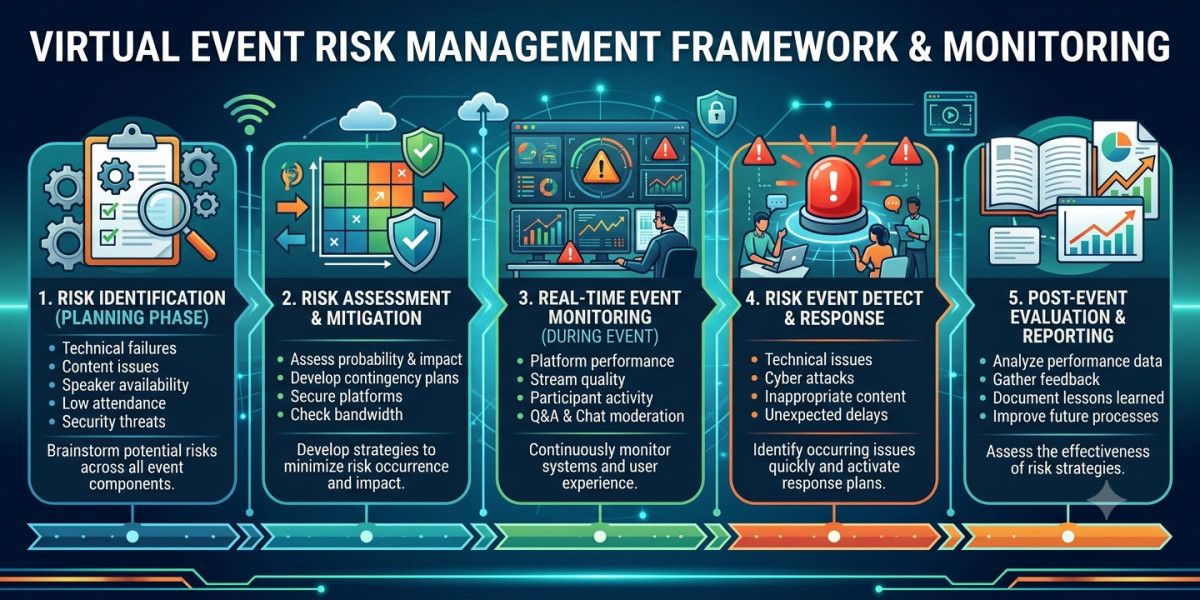
You cannot successfully manage a digital crisis using static, pre-event safety plans alone. Once the broadcast goes live, your team must immediately shift into an active state of risk event monitoring to detect and address technical and operational anomalies before they are visible to your audience.
This active oversight process requires setting up integrated dashboards that track multiple data streams concurrently. Your technical team must continuously observe real-time platform latency, user authentication failure rates, and irregular chat spikes. For instance, a sudden drop in stream delivery speed or an unexpected spike in failed login attempts is often the earliest indicator of a localized server failure or a coordinated cyberattack. By establishing clear notification thresholds, your engineering team can seamlessly reroute web traffic to secondary fallback servers or isolate compromised user segments long before the viewer experience is impacted.
Standardizing Your Operational Architecture
Operating with confidence in high-stakes environments requires moving completely away from informal check-ins and unverified system configurations. Every technical dependency, emergency fallback procedure, and staff responsibility must be meticulously documented and standardized well ahead of your production schedule.
Building this structured operational blueprint requires using professional, industry-vetted templates. Utilizing specialized, comprehensive risk checklists from established safety providers like safety docs ensures that your platform architecture, vendor access parameters, and data protection policies meet strict corporate compliance standards. Having these standardized frameworks in place ensures that if a crisis does occur, your production crew doesn't waste precious time debating responsibilities they can execute pre-planned, field-tested recovery protocols instantly.
Actionable Mitigation Tactics for Production Crews
Producers should never assume a platform is inherently secure simply because it is provided by an established enterprise vendor. Implement these practical, technical strategies to reinforce your digital boundaries:
Implement Redundant Stream Engineering
Dual-Ingest Architecture: Always configure your primary broadcast encoders to output simultaneous streams to two geographically isolated ingress points, ensuring a seamless, automated switch if one data center fails.
Isolated Back-Up Feeds: Keep a pre-recorded, high-quality version of critical presentations or keynotes queued on an independent backup media player, ready to go live instantly if a presenter's home network fails completely.
Establish Tiered Moderation Matrixes
Automated Text Filtering: Deploy AI-driven text moderation algorithms across all public interactive areas to instantly block malicious links, commercial spam, and inappropriate language before it appears on screen.
Human Escalation Pathways: Assign dedicated moderators to specific viewer segments, providing them with clear authority to instantly revoke user permissions, mute compromised feeds, or escalate technical issues to senior engineers.
Securing Your Digital Legacy
The success of a modern event is no longer measured solely by the quality of the stage lighting or the elegance of a physical venue; it is defined by the absolute security, stability, and integrity of the digital space you create. Online environments are dynamic, unpredictable landscapes that require continuous vigilance, robust technical redundancies, and proactive regulatory compliance. By prioritizing thorough digital risk assessments and implementing advanced, real-time tracking protocols, you can confidently defend your brand’s reputation, safeguard sensitive consumer data, and deliver a seamless, impactful presentation from the opening slide to the final broadcast frame.
Key Takeaway
Flawless digital execution requires moving past basic streaming configurations. By integrating an exhaustive framework for virtual event risk management and maintaining continuous, real-time risk event monitoring, coordinators can neutralize security breaches, protect attendee data, and guarantee uninterrupted platform performance.
Frequently Asked Questions
Q1: What is the most common cause of platform failure during a large digital assembly?
The primary driver of platform failure is unexpected concurrency spikes, where thousands of users attempt to authenticate, process payments, or load video streams simultaneously, completely overwhelming unoptimized server databases.
Q2: How does GDPR apply if my company is based in the United States?
If your digital event registers or tracks even a single attendee residing within the European Union, your data processing, consent forms, and storage tracking methods must fully comply with all GDPR mandates regardless of your corporate location.
Q3: Can a virtual event organizer be held legally liable for user-generated chat content?
Yes. If an organizer fails to provide reasonable moderation oversight and allowing defamatory, illegal, or severely toxic content to remain visible on screen, they can face substantial corporate liability claims.
Q4: What is the difference between a primary stream and a backup stream ingest point?
A primary stream sends your video data to a specific network server, while a backup ingest point routes identical data to an entirely independent, geographically separate server center to ensure continuity if the primary location crashes.
Q5: How frequently should technical stress testing be conducted before going live?
Full-scale load and stress testing should be executed at least two weeks prior to the event date, simulating up to 150% of your peak projected audience volume to identify hidden infrastructure bottlenecks early.


