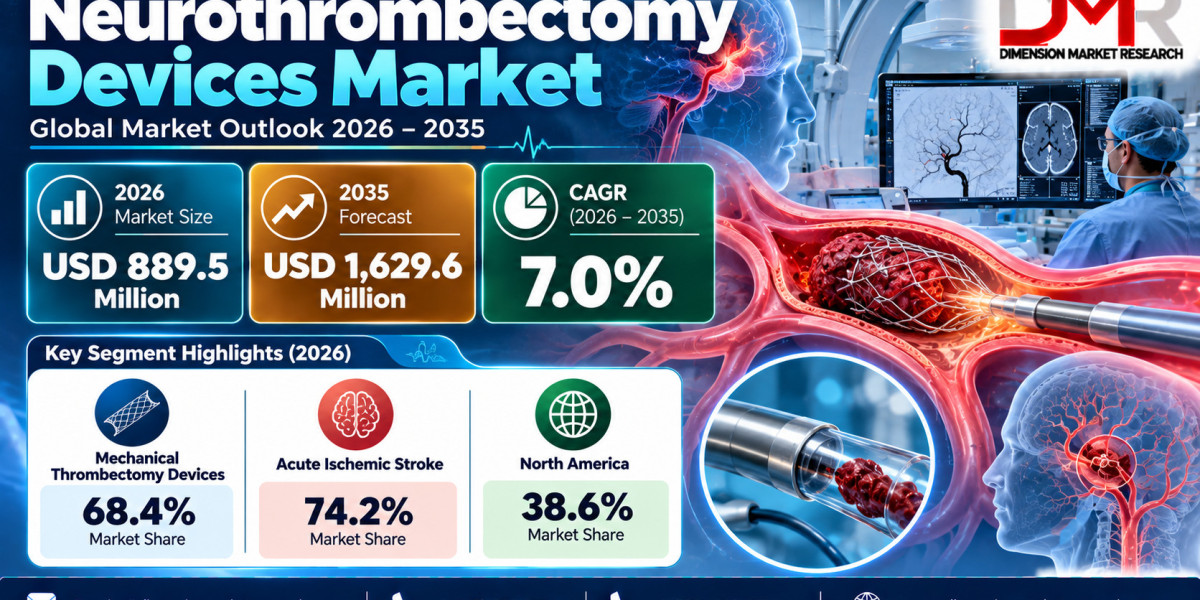

The global Neurothrombectomy Devices Market is expanding as healthcare systems invest in minimally invasive stroke treatment, advanced neurovascular devices, and faster emergency intervention. According to Dimension Market Research, the market is projected to increase from USD 889.5 million in 2026 to USD 1,629.6 million by 2035, registering a CAGR of 7.0%.
Rising stroke incidence, aging populations, and improvements in emergency stroke care are encouraging hospitals to adopt advanced clot retrieval technologies. Mechanical thrombectomy devices help restore cerebral blood flow in selected patients with acute ischemic stroke, reducing the risk of long-term neurological disability.
Advances in stent retrievers, aspiration catheters, AI-assisted imaging, and integrated stroke care networks are creating opportunities for medical device manufacturers, hospitals, and neurointerventional technology providers.
What Is the Neurothrombectomy Devices Market?
The Neurothrombectomy Devices Market includes specialized medical devices used to remove blood clots from cerebral blood vessels through minimally invasive endovascular procedures.
Major products include stent retrievers, aspiration catheters, microcatheters, balloon guide catheters, guidewires, and introducer sheaths.
These devices support treatment of eligible patients with acute ischemic stroke caused by vessel occlusion. Their use depends on clinical assessment, vascular imaging, treatment timing, and specialist expertise.
The market serves hospitals, comprehensive stroke centers, and other facilities equipped to provide neurointerventional care.
Why Is the Neurothrombectomy Devices Market Growing?
Increasing stroke burden is a major growth driver. Aging populations and risk factors such as hypertension, diabetes, and atrial fibrillation contribute to demand for effective stroke treatment.
Improved clinical recognition of mechanical thrombectomy is encouraging healthcare institutions to strengthen emergency stroke pathways and expand specialist services.
Technological innovation is another important factor. Advanced catheter flexibility, improved clot capture mechanisms, and combined aspiration techniques support more efficient procedures.
However, high device and procedure costs, specialized infrastructure requirements, and shortages of trained neurointerventionalists remain significant barriers.
Get a Free Sample of the Neurothrombectomy Devices Market Report
Explore detailed revenue forecasts, device segmentation, thrombectomy technologies, clinical indications, regional opportunities, and competitive intelligence through Dimension Market Research's sample report. These findings can support medical device investment, product development, and healthcare market expansion strategies.
https://dimensionmarketresearch.com/request-sample/neurothrombectomy-devices-market/
Neurothrombectomy Devices Market Size and Key Statistics
● 2026 Market Size: USD 889.5 Million
● 2035 Forecast Revenue: USD 1,629.6 Million
● Forecast CAGR: 7.0%
● U.S. Market Size (2026): USD 300.0 Million
● Europe Market Size (2026): USD 251.9 Million
● Japan Market Size (2026): USD 44.5 Million
● Leading Product: Mechanical Thrombectomy Devices, 68.4%
● Leading Technology: Stent-Based Thrombectomy, 46.7%
● Leading Indication: Acute Ischemic Stroke, 74.2%
● Leading End User: Hospitals, 52.9%
● Leading Region: North America, 38.6%
All segment and regional shares refer to 2026.
Market Segmentation: Mechanical Thrombectomy Devices Lead
Mechanical thrombectomy devices dominate product segmentation with a 68.4% market share in 2026, supported by their central role in endovascular clot removal procedures.
Stent retrievers and aspiration catheters are widely used to restore blood flow in selected large vessel occlusion cases. Improvements in flexibility, clot engagement, and navigation are strengthening product development.
Stent-based thrombectomy leads the technology segment with a 46.7% share, supported by clinical evidence and established use in stroke care.
Acute ischemic stroke represents the largest indication with a 74.2% share, reflecting the importance of rapid intervention in eligible patients.
Hospitals dominate end-user demand with 52.9% share, while comprehensive stroke centers represent an important growth opportunity.
How AI and Advanced Imaging Are Transforming Stroke Treatment
Artificial intelligence is influencing emergency stroke diagnosis, patient assessment, and neurointerventional workflows.
AI-assisted imaging systems can help identify suspected large vessel occlusions and support faster communication between emergency teams and stroke specialists.
Advanced perfusion imaging also supports treatment eligibility assessment, including selected patients presenting beyond conventional treatment windows.
Meanwhile, direct aspiration and combined thrombectomy techniques are expanding procedural options.
The ADAPT technique, which uses aspiration catheters for direct clot removal, is identified as the fastest-growing technology segment.
These developments encourage manufacturers to improve catheter design, clot retrieval performance, and compatibility with imaging systems.
Regional Outlook: North America Leads, Asia Pacific Grows Fastest
North America leads the Neurothrombectomy Devices Market with a projected 38.6% revenue share in 2026.
The region benefits from established healthcare infrastructure, comprehensive stroke centers, reimbursement systems, and clinical research activity.
The United States market is projected to reach USD 300.0 million in 2026, supported by advanced neurointerventional facilities and adoption of endovascular stroke treatment.
Europe represents another important market, with projected revenue of USD 251.9 million in 2026. Germany, France, and the United Kingdom are strengthening stroke networks and specialist treatment capacity.
Asia Pacific is identified as the fastest-growing region. Investments in stroke centers, physician training, and healthcare modernization across China, India, and Japan are supporting adoption.
Japan's market is projected to reach USD 44.5 million in 2026, reflecting demand associated with its aging population and established healthcare infrastructure.
Competitive Landscape and Strategic Opportunities
Major companies identified in the report include Stryker, Medtronic, Penumbra, Johnson & Johnson (Cerenovus), Terumo Corporation, Phenox GmbH, Rapid Medical, MicroVention, Balt Extrusion, Vesalio, and Acandis GmbH.
Competition focuses on device innovation, clot retrieval efficiency, catheter navigation, clinical validation, and specialist training.
Manufacturers are investing in advanced stent retrievers, aspiration systems, and integrated procedural solutions.
Partnerships with hospitals and stroke centers offer opportunities to support device evaluation, physician education, and adoption of new technologies.
Future Outlook for the Neurothrombectomy Devices Market
Through 2035, market expansion is expected to reflect increasing stroke treatment demand, improved patient identification, and development of specialized neurovascular devices.
Combined thrombectomy techniques, AI-assisted triage, and advanced catheter technologies will influence innovation.
Expanding treatment infrastructure in emerging economies and improving access to trained specialists represent important opportunities for manufacturers and healthcare providers.
Explore the Complete Neurothrombectomy Devices Market Analysis
Access the comprehensive Dimension Market Research report for detailed revenue forecasts, product segmentation, technology comparisons, regional analysis, competitive benchmarking, and strategic opportunities across the neurointerventional device industry.
https://dimensionmarketresearch.com/checkout/neurothrombectomy-devices-market/
Frequently Asked Questions
1. What is the global Neurothrombectomy Devices Market size?
The market is projected to grow from USD 889.5 million in 2026 to USD 1,629.6 million by 2035.
2. What is the expected CAGR of the Neurothrombectomy Devices Market?
The market is forecast to expand at a CAGR of 7.0% during 2026 to 2035.
3. Which product segment leads the market?
Mechanical thrombectomy devices lead with a projected 68.4% revenue share in 2026.
4. Which region dominates the Neurothrombectomy Devices Market?
North America leads with a projected 38.6% market share in 2026.
5. Which region is expected to grow fastest?
Asia Pacific is identified as the fastest-growing region, supported by expanding stroke treatment infrastructure, healthcare investment, and specialist training.
Conclusion
The Neurothrombectomy Devices Market is evolving as healthcare systems prioritize faster stroke diagnosis, minimally invasive treatment, and improved access to neurointerventional care.
Mechanical thrombectomy devices, stent-based technologies, and acute ischemic stroke procedures remain central to market demand.
AI-assisted imaging, advanced aspiration systems, specialist training, and expansion of stroke treatment networks will create important opportunities through 2035.