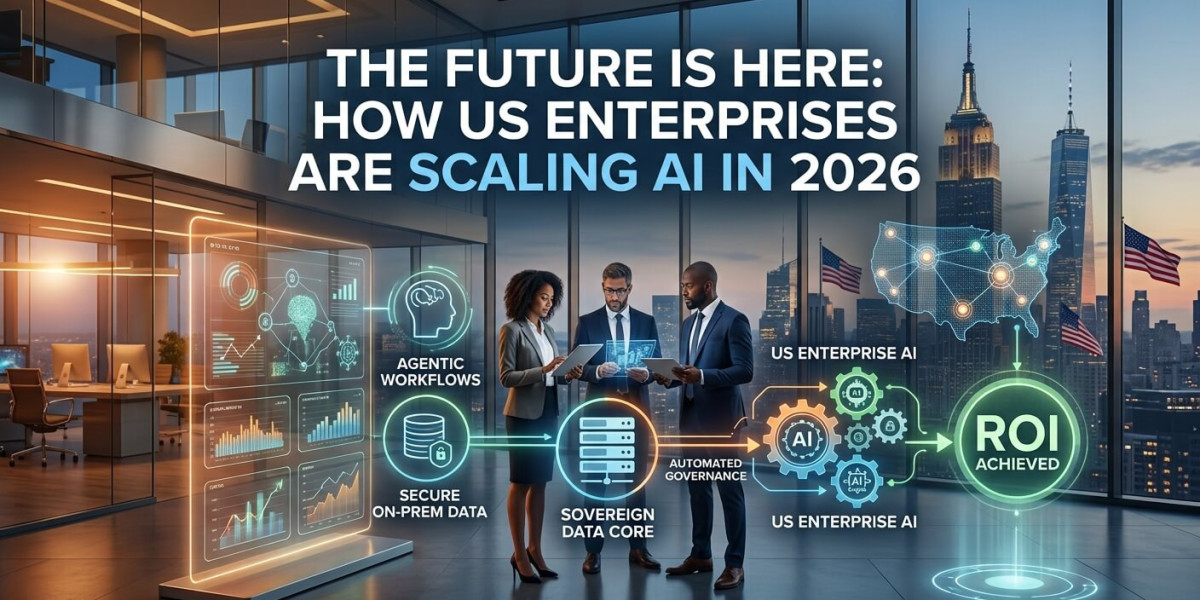

Over the past few years, artificial intelligence dominated corporate headlines across the United States. Organizations spent millions experimenting with large language models (LLMs) and internal chatbots. However, the tech landscape has fundamentally shifted. US enterprises are moving past simple productivity tools to build autonomous systems that drive measurable return on investment (ROI).
From financial services on Wall Street to healthcare networks in California, business leaders are integrating AI directly into core operational architecture. Here are the three defining trends reshaping enterprise automation across North America today.
1. The Shift to Agentic AI: Autonomous Workflows in Production
The era of static, prompt and response AI is winding down. Enterprise automation in 2026 is defined by Agentic AI autonomous systems capable of planning, executing multi step tasks, and making dynamic decisions without needing human hand holding at every turn.
Unlike standard chatbots, AI agents can trigger complex API calls, query internal databases, update CRM systems, and resolve software tickets independently.
IT & Operations: Autonomous security agents detect real time data breaches and isolate compromised endpoints in seconds.
Supply Chain Management: Multi agent systems automatically adjust logistics routing based on port delays or severe weather patterns across North America.
Financial Services: Automated document agents evaluate loan applications, verify compliance, and run risk profiles with minimal human oversight.
Enterprise software applications are aggressively embedding task specific agents into everyday tools. Organizations that embrace these autonomous workflows are seeing a massive reduction in decision latency and operational overhead.
2. Sovereign AI and On Premises Deployments Gain Traction
Data privacy concerns, strict federal regulations, and rising cloud compute costs have triggered a massive surge in Sovereign AI and localized infrastructure. While early enterprise AI adoption leaned heavily on public cloud infrastructure, top tier US firms are pivoting to hybrid and on premises architectures.
Highly regulated sectors such as defense, healthcare (HIPAA compliance), and banking cannot afford to stream sensitive customer data or proprietary source code to multi tenant public cloud APIs.
To mitigate geopolitical risks and intellectual property leaks, companies are training specialized, domain specific models directly on localized hardware. According to enterprise tech insights from McKinsey & Company, building targeted, high performing internal models provides greater long term cost efficiency and tighter control over corporate governance.
3. Continuous AI Governance and Risk Mitigation
As enterprise AI agents take on higher operational authority, corporate governance has become a top priority for C suite executives. Out of control AI models can create significant legal vulnerabilities, hallucinations, and cybersecurity risks.
US enterprises are deploying automated governance stacks that sit alongside their operational AI pipelines to maintain safety. These systems provide continuous monitoring, automated compliance logging, and real time hallucination checks:
By standardizing continuous testing and mandatory "human in the loop" approval thresholds for high stakes decisions, enterprise teams can innovate quickly without violating federal data compliance guidelines.
FAQS
Q1: What is the main difference between generative AI chatbots and agentic AI?
Traditional generative AI tools primarily respond to prompts by generating text or simple outputs. In contrast, agentic AI systems are designed to operate autonomously. They can plan multi step workflows, execute complex tasks across enterprise APIs, make context aware decisions, and interact directly with internal databases without requiring step by step human prompt.
Q2: Why are US enterprises shifting toward on premises and sovereign AI solutions?
Many companies in highly regulated American industries (such as financial services, healthcare, and defense) face stringent data privacy standards like HIPAA and emerging federal compliance rules. On premises and sovereign AI deployments keep sensitive customer data, proprietary source code, and trade secrets within controlled corporate boundaries rather than routing them through public multi tenant cloud APIs.
Q3: How do organizations measure the ROI of enterprise AI in 2026?
Instead of focusing solely on time saved per employee or simple software utilization metrics, enterprise ROI is measured by operational outcome improvements. Key performance metrics include reduced decision latency, automated error correction rates, lower compliance costs, and cycle time reductions in core workflows like customer onboarding, supply chain routing, and financial reconciliation.
Q4: What role does continuous human oversight play in automated enterprise workflows?
Human in the loop (HITL) architecture acts as a safety layer within automated systems. While AI agents manage routine tasks independently, established thresholds automatically escalate high stakes decisions, regulatory exceptions, or ambiguous anomalies to human operators for final approval before execution.
Building a Scalable AI Infrastructure for Tomorrow
Enterprise automation is no longer about testing basic generative writeups; it is about orchestrating autonomous, secure, and domain tailored software networks. US companies that succeed will be those that pair agentic execution with strong data sovereignty and automated risk management protocols.


